Between the day you choose a flat and the day you get its keys, two documents hold the deal together: the allotment letter and the agreement for sale. The first reserves the flat. The second is the contract that the Real Estate (Regulation and Development) Act, 2016 enforces. In Maharashtra both follow formats set by MahaRERA, and parts of them cannot be changed by the developer at all.
Neither document exists yet for Codename Vybe. A MahaRERA registration number has not been published, and under Section 4(2)(g) of the Act a promoter files the proforma of its allotment letter, agreement for sale and conveyance deed with its application for registration. This guide explains what to look for when those drafts are available.
The allotment letter: reserving the flat
The allotment letter is issued when you book. Since 2022 it has had to follow a model format approved by MahaRERA. The law firm Argus Partners reported in July 2022 that MahaRERA’s Order No. 31 of 1 July 2022 lets a promoter alter the cancellation clause only in the buyer’s favour, by allowing more days to cancel or a smaller deduction.
The letter identifies the flat, with its carpet area and price, and records what you have paid. Its cancellation table, as a Free Press Journal column of January 2024 summarised MahaRERA’s Order No. 35 of 12 August 2022, works like this:
| You ask to cancel | Most the developer can deduct |
|---|---|
| Within 15 days of the allotment letter | Nothing |
| 16 to 30 days | 1 per cent of the flat’s price |
| 31 to 60 days | 1.5 per cent |
| After 60 days | 2 per cent |
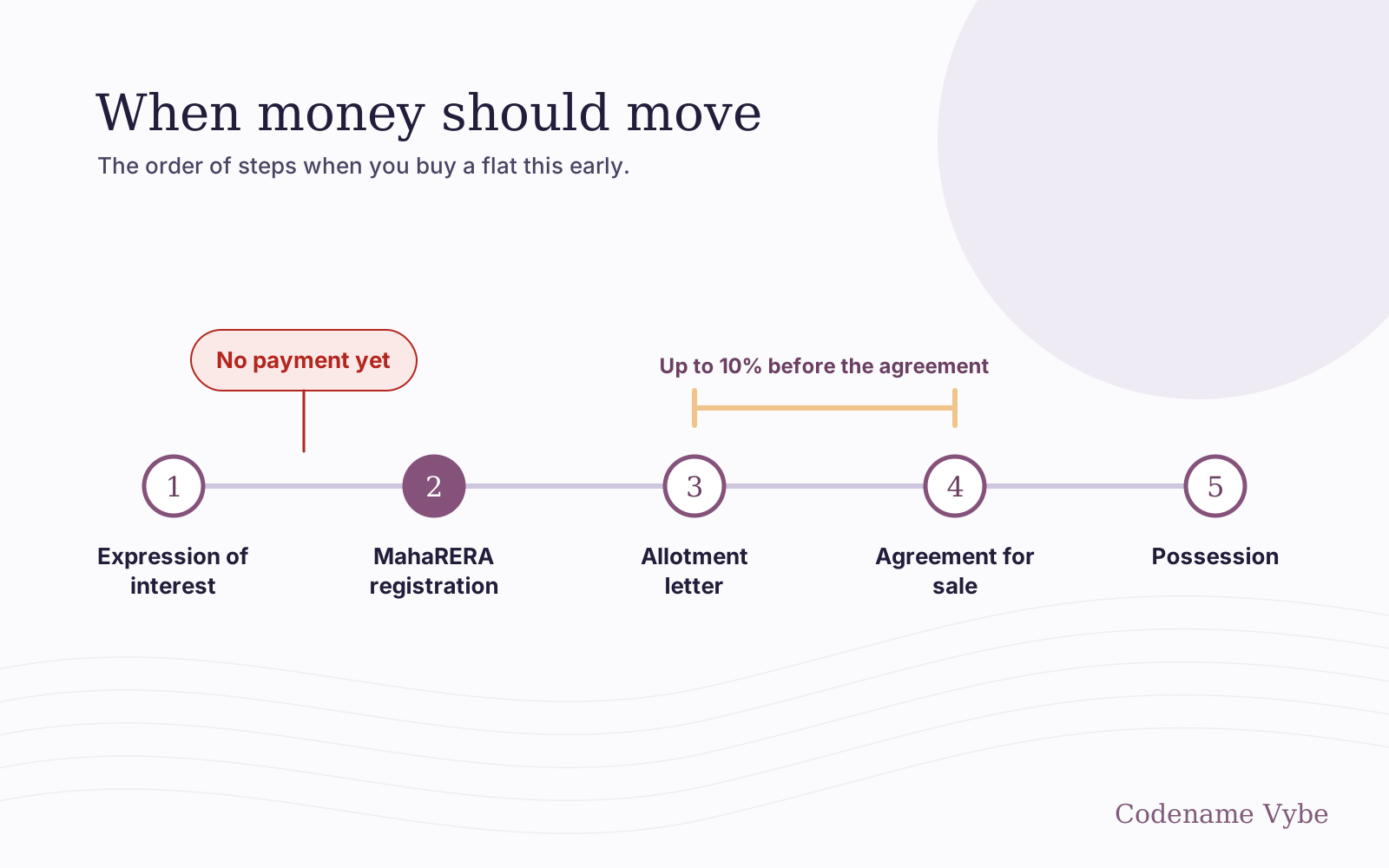
The balance has to be refunded within 45 days of cancellation. Two more rules apply at this stage. Under Section 11(3) of the Act, at booking and when the allotment letter is issued, the promoter has to make available the sanctioned plans, layout plans and specifications, and the stage-wise schedule for completing the project. And under Section 13, the promoter cannot take more than ten per cent of the cost of the flat before a written agreement for sale is signed and registered.
The agreement for sale: the contract RERA enforces
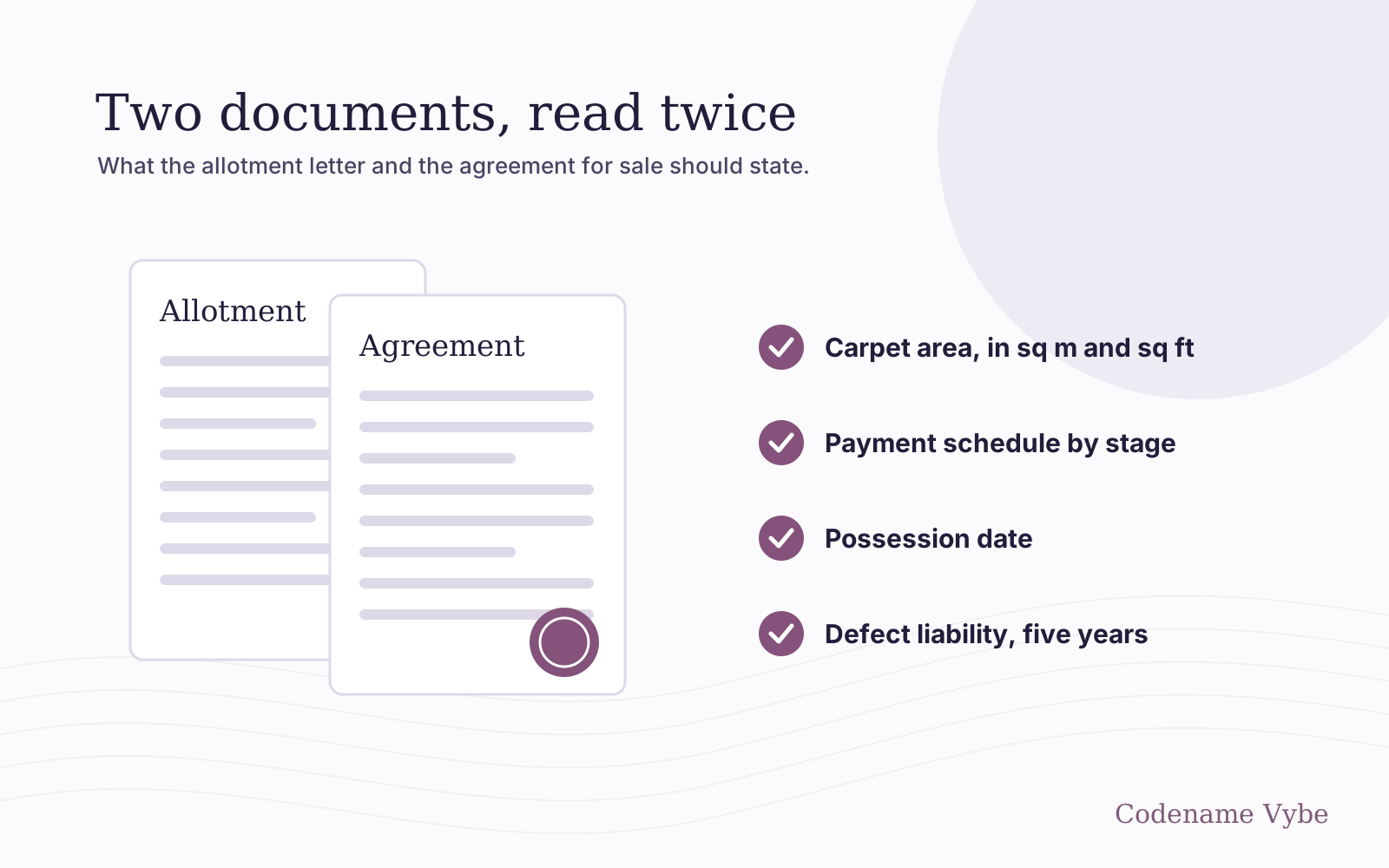
Section 13(2) says the agreement for sale must be in the prescribed form and must specify the particulars of development, including the construction of the building and the flat with its specifications, the dates and manner of payments, the date on which possession will be handed over, and the rates of interest each side pays the other on default. In Maharashtra the prescribed form is the model agreement in Annexure A to Rule 10 of the state’s RERA rules of 2017.
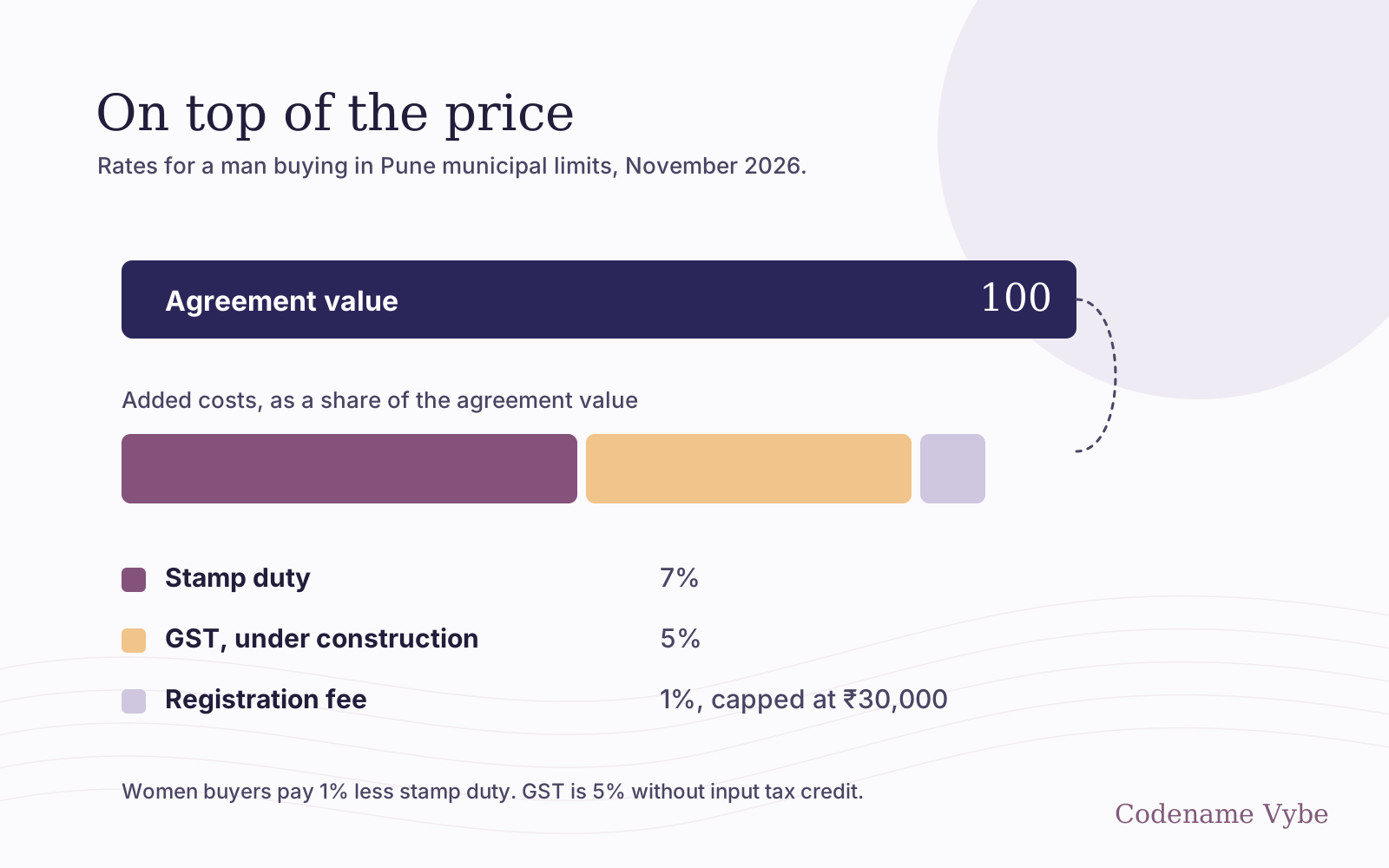
The agreement is registered at the sub-registrar’s office, which is when stamp duty and the registration fee are paid. The amounts are explained in the piece on stamp duty, registration and GST.
In Order No. 38 of 13 December 2022, MahaRERA named clauses of the model agreement that developers may not change, and said that any clause contrary to the Act, or to those clauses, is void from the start and does not bind buyers. Here is what the main clauses commit the developer to:
| Clause | What it commits the developer to | Source |
|---|---|---|
| Carpet area | The usable area of the flat as defined in Section 2(k) of the Act, stated in square metres, with balconies and terraces shown separately | The Act and the model agreement |
| Carpet area variation | Final carpet area confirmed after the occupancy certificate, within a 3 per cent variation. If it is smaller, the excess you paid comes back within 45 days with interest; if larger, the extra is payable at the next milestone | Model agreement; non-negotiable under Order No. 38 |
| Payment schedule | The dates and manner of every payment, which on a flat under construction are tied to construction stages | Section 13(2) |
| Possession date | A date for handover. If it is missed, you are entitled to interest for every month of delay until possession, or to withdraw and get your money back with interest | Sections 13(2) and 18 |
| Interest rate | The same rate both ways: the State Bank of India’s highest marginal cost of lending rate plus 2 per cent | Rule 18 of the Maharashtra RERA rules, 2017 |
| Defect liability | Structural defects, or defects in workmanship, quality or services, reported within five years of handover are fixed without charge within 30 days | Section 14(3) |
| Termination for default | The developer can end the agreement for payment default only after 15 days’ written notice, and must then refund what you paid within 30 days, less agreed deductions | Non-negotiable under Order No. 38 |
| Amenities | A list of facilities and amenities with a delivery date for each, phase by phase | MahaRERA order reported by the Free Press Journal on 31 July 2024 |
| Plan changes | No change to your flat’s sanctioned plan without your written consent, minor changes apart, and no other change to the building’s plans or common areas without the consent of two-thirds of buyers | Section 14(2) |
Carpet area is the clause buyers most often misread. The piece on carpet area explains what the number includes and what it leaves out.
What to check before you sign
- Match it to the allotment letter. The flat number, carpet area and total price should be identical.
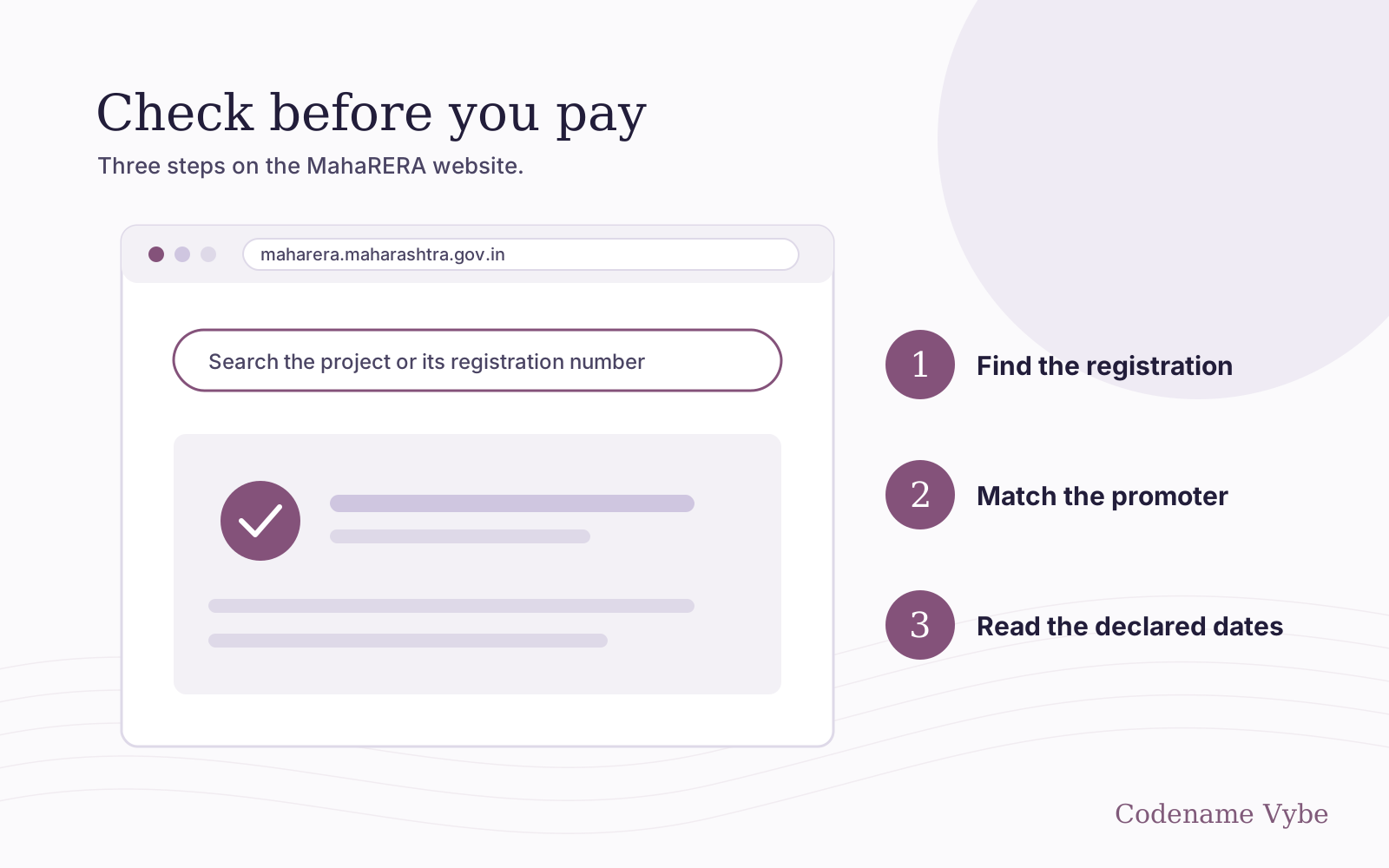
- Match it to MahaRERA. The promoter’s name, the building and the carpet area should match the project’s registration.
- Read the payment schedule. Each instalment should be tied to a stage of construction, and nothing above ten per cent should be due before the agreement is registered.
- Look for a date. The possession clause should name one. Under Section 6 of the Act, force majeure means war, flood, drought, fire, cyclone, earthquake or another natural calamity; MahaRERA’s 2022 order flagged agreements that stretch it further.
- Compare the fixed clauses. The carpet area variation and termination clauses should read as they do in the model agreement, and the defect liability period should be five years.
- Check the amenities. Every amenity shown in the brochure should be in the schedule, with a delivery date.
- Get it early. Ask for the draft well before the registration appointment, and have your own lawyer read it.
What is fixed for Codename Vybe, and what is not
The floor plans on this website come from the developer’s working drawings, which note that carpet areas and room sizes may change once final column positions are fixed. The brochure promises more than twenty amenities and names eight, and the final list will follow the sanctioned plans. The specifications also come from the developer’s working presentation. The figures that will bind are the ones in your registered agreement for sale, and with no MahaRERA registration yet, there is nothing to sign or pay for today.
You can compare the current floor plans, amenities and specifications now, so you know what to look for in the agreement later. This is general information about the Act and MahaRERA’s orders, not legal advice.
When the draft documents are available, you can ask for copies on the contact page.