For most of the last decade, the complaint about Sinhagad Road was the drive into town, not the neighbourhoods along it. The flyover the Pune Municipal Corporation (PMC) built between Rajaram Bridge and Fun Time Theatre was meant to answer that complaint. It opened in three pieces between August 2024 and September 2025, and it has now been in use long enough to say plainly what it changed and what it left alone.
What was built, and when
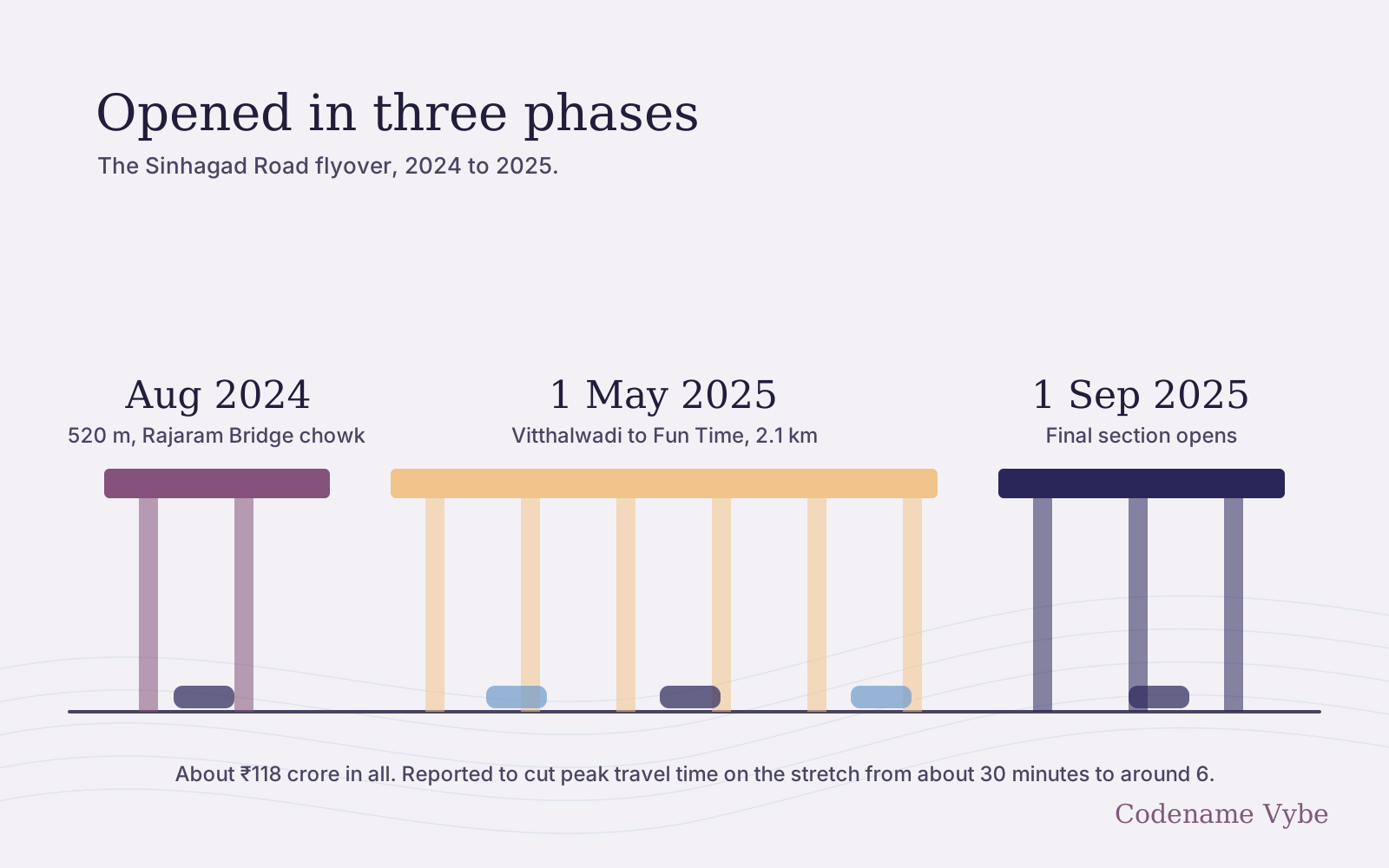
The flyover did not open in one go. The Free Press Journal, reporting the final inauguration on 1 September 2025, set out three phases and their costs, which add up to about ₹118 crore. Punekar News put the total at ₹118.37 crore the same day, and said work had started in September 2021.
| Phase | Stretch | Opened | Reported cost |
|---|---|---|---|
| 1 | About 520 m at Rajaram Bridge chowk | 15 August 2024 | ₹15 crore |
| 2 | About 2.1 km, Vitthalwadi to Fun Time Theatre | 1 May 2025 | ₹61 crore |
| 3 | About 1.5 km, Goyal Ganga Chowk to Inamdar Chowk | 1 September 2025 | ₹42 crore |
Deputy Chief Minister Ajit Pawar opened the first two sections and Chief Minister Devendra Fadnavis inaugurated the last, the Free Press Journal reported in September 2025. Reported lengths vary a little. Punekar News gave the second phase as 2.2 km when it opened in May 2025, while most later reports use 2.1 km, so treat every length here as approximate.
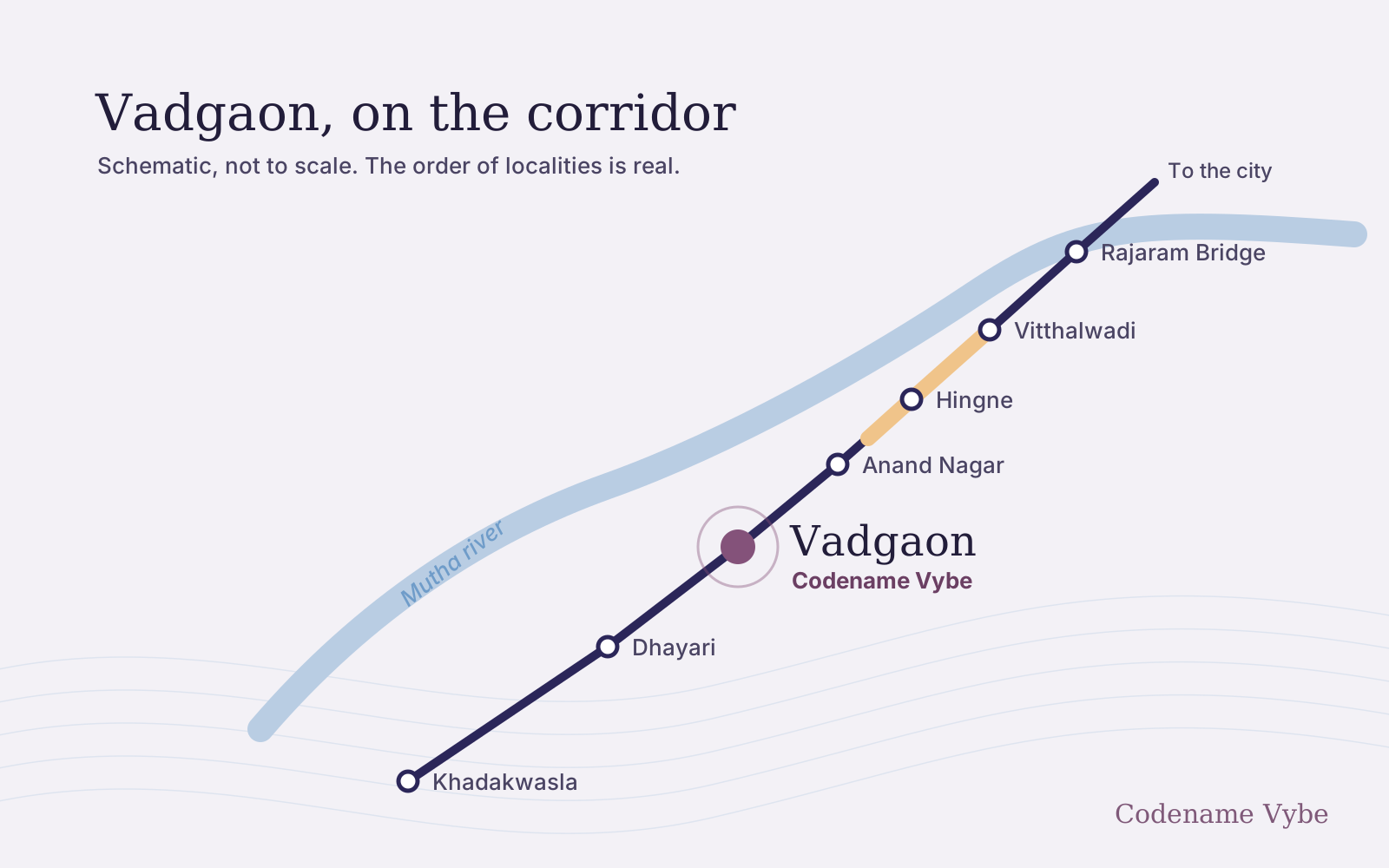
The same May 2025 Punekar News report said the first section runs one way, from Rajaram Bridge towards Swargate, and that the second phase lifts traffic over Inamdar Chowk, Hingne Chowk, Santosh Hall Chowk, Dutt Hotel Chowk and Goyal Ganga Chowk.
What it changed
The headline number came from Punekar News on the day of the final inauguration in September 2025. The stretch of about 2.6 km between Rajaram Bridge and Fun Time Theatre, which used to take around 30 minutes at peak through six signals, could now be crossed in five to six minutes. The same report said Sinhagad Road carries more than 1.5 lakh vehicles a day, and that the road beneath the flyover had been rebuilt with three lanes, wide footpaths, parking and landscaped dividers.
That second part matters more than it sounds. The shops, schools and bus stops are on the road below. A flyover with a neglected surface road underneath would have helped through traffic at the expense of the people who actually live on the corridor.
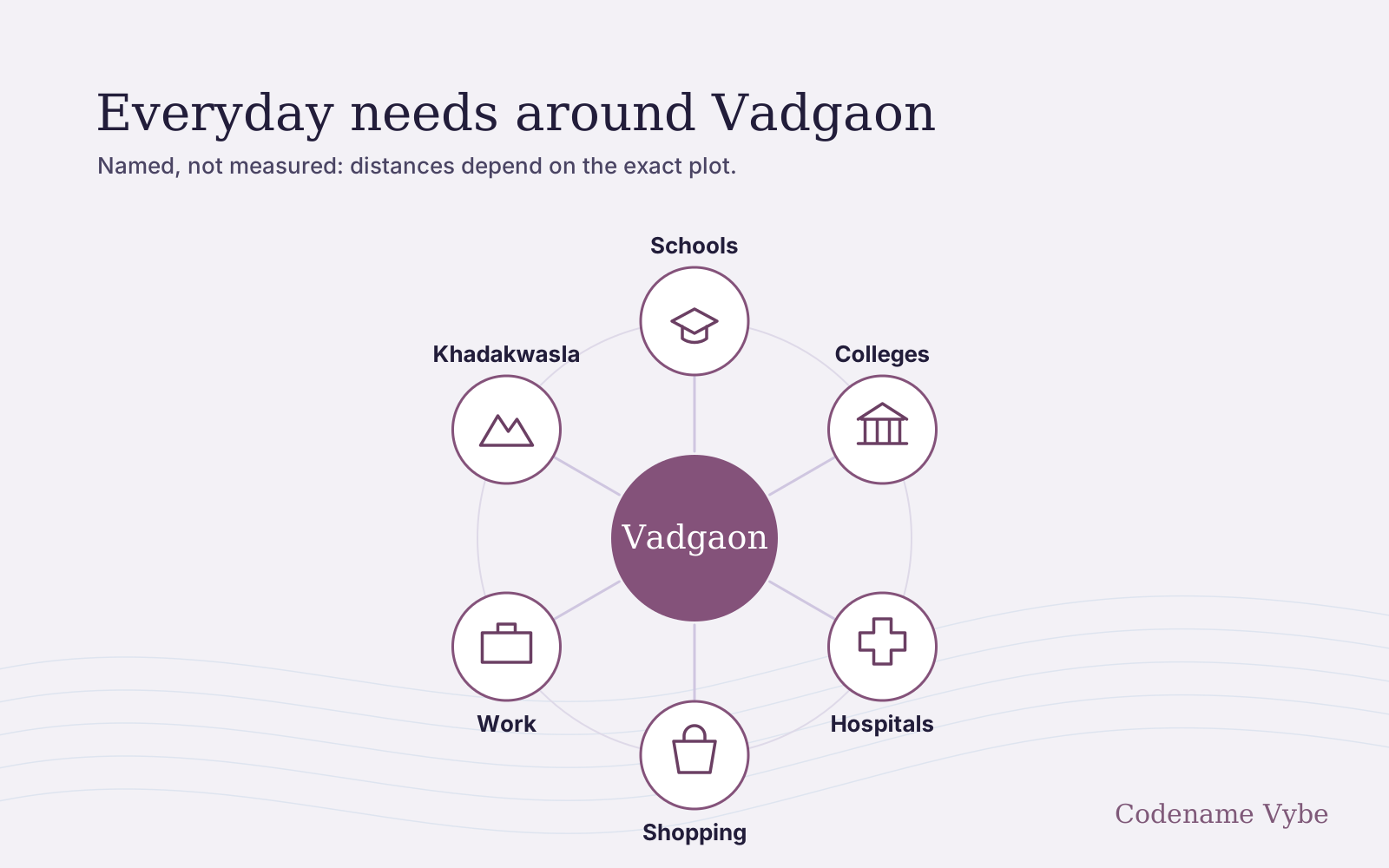
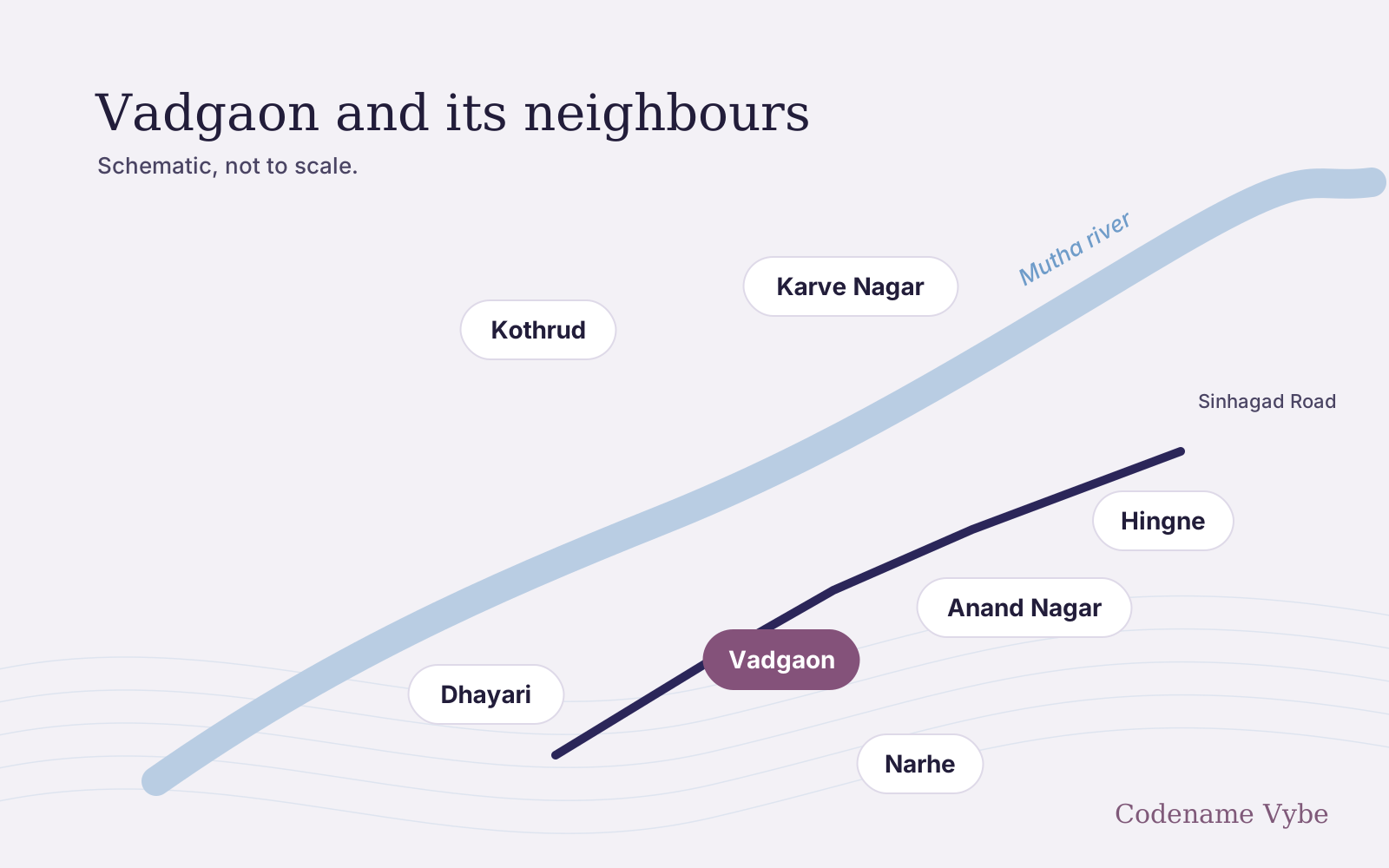
For someone living at Vadgaon, the flyover covers the stretch you drive to reach Rajaram Bridge, from Fun Time inwards. How much of a particular commute it saves depends on where you join the road and where you are going.
What it did not fix
A flyover carries cars over junctions. It does not make the ends of the flyover disappear, and the first year of use has shown where the pressure went.
- The approaches. The day after the final inauguration, Punekar News reported in September 2025 that the connecting road at the Vitthalwadi end was narrow and potholed, and that residents near Goyal Ganga felt the unfinished approach cancelled part of the benefit. One commuter told the paper the crossing now took about 10 minutes, not six.
- Peak-hour queues on the flyover itself. A week after the opening, the Free Press Journal published video in September 2025 of a morning snarl on the new flyover.
- The Fun Time end. Resident reviews on NoBroker’s Vadgaon Budruk page, with figures stated as of August 2026, still complain of evening jams at the Fun Time multiplex signal and of peak-hour bottlenecks near Navale Bridge.
- Rajaram Bridge itself. The Free Press Journal reported in August 2026 that the bridge is about 18 m wide against the 30 m the development plan requires. The PMC had appointed a project management consultant for widening it and set aside ₹8.5 crore in its budget for the year ending March 2027, but the project had no financial approval and no start date.
The metro will reopen the works
The flyover is also going to be cut into. When the second phase opened, the Free Press Journal reported in May 2025 that people online feared the new structure would be broken up for the metro. A PMC executive engineer said then that the flyover had been planned with the metro route in mind, with markings already made where the pillars would go.
The detail came later. Punekar News reported in December 2025 that 105 metro pillars are planned between Rajaram Bridge and Vadgaon, roughly every 30 m. Foundations for 39 were built while the flyover went up. The remaining 66 need the flyover deck to be partly cut, narrowing each side from 7.324 m to 6.324 m, with the metro running 5.5 m above. The PMC said two lanes would stay open on each side once the work is complete.
“Once the work is complete” is the phrase to notice. While those 66 cuts are being made, the flyover is unlikely to carry traffic the way it does today. Where the metro itself stands is covered in a separate article on its approval and timeline.
How to judge it for yourself
Drive the route at the hour you would actually drive it, on a weekday, in both directions. Then do it again on another day, because one good or bad morning proves nothing. Note where the queue starts, not just how long the flyover took. That is a test no brochure, including this one, can influence.
The location page sets out how Vadgaon sits on the corridor. Because the exact plot for Codename Vybe has not been published, this site gives no drive times from it. If you would like the exact location before you do that test drive, or want to book a site visit, you can ask us here.