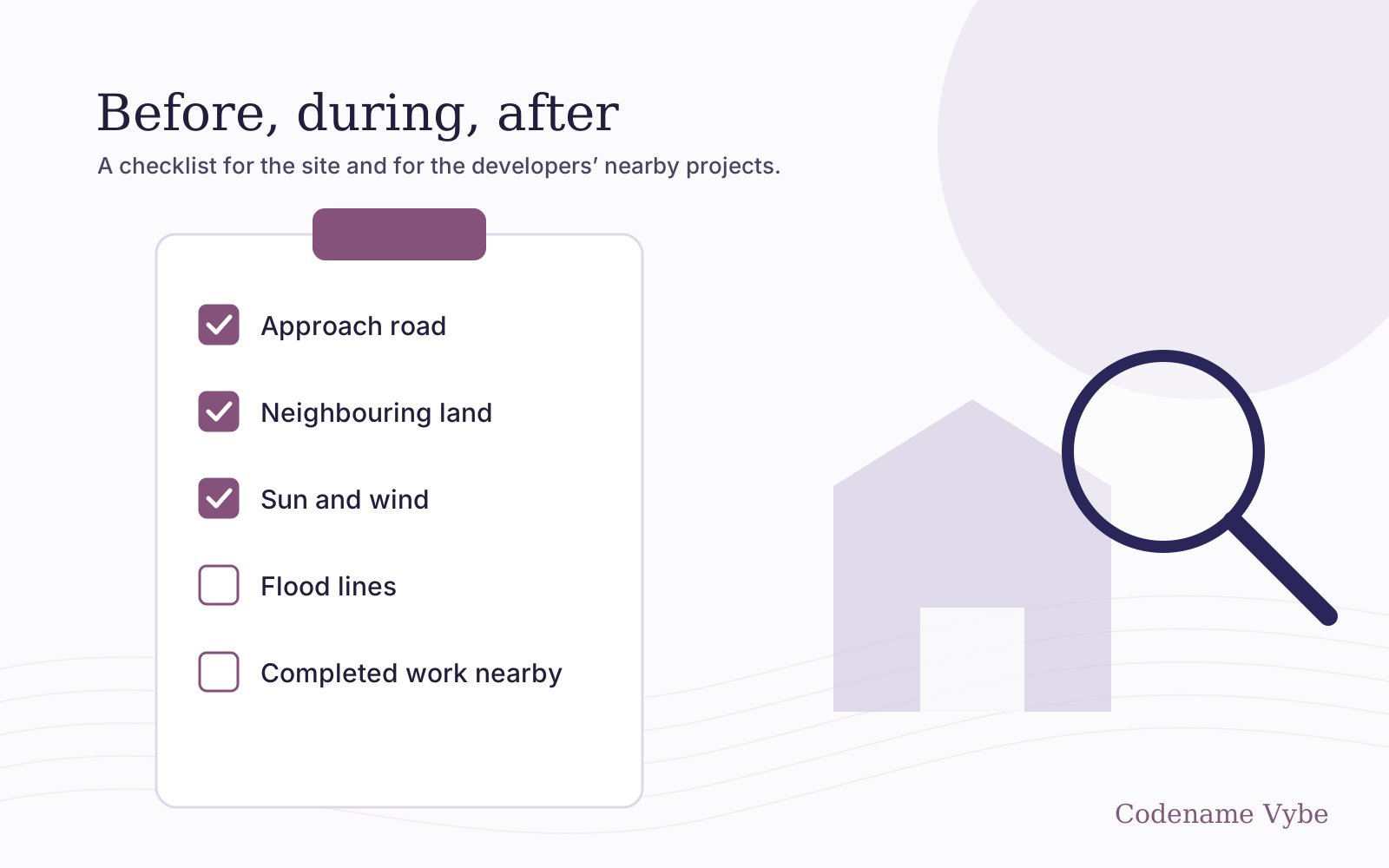
At pre-launch there is usually little to see on the plot itself. Most of what a site visit can tell you comes from the surroundings, the questions you ask and the documents you are shown, and from the developer’s existing buildings, which show how earlier promises turned out.
For Codename Vybe, both developers have registered projects on the same stretch of Sinhagad Road. Ranawat Group’s Aura Waters is at Anand Nagar, Vadgaon Budruk, with Phase I registered with MahaRERA under P52100047184. Welworth Realty’s Welworth Bluescapes is at Wadgaon Budruk, registered under P52100028477. This checklist covers a visit to the site and to buildings like these. We do not describe either project here: the point of the visit is to judge them for yourself.
Before you go
- Get the exact location. The site location for Codename Vybe is shared on enquiry. Distances quoted on property portals are not measured from your building.
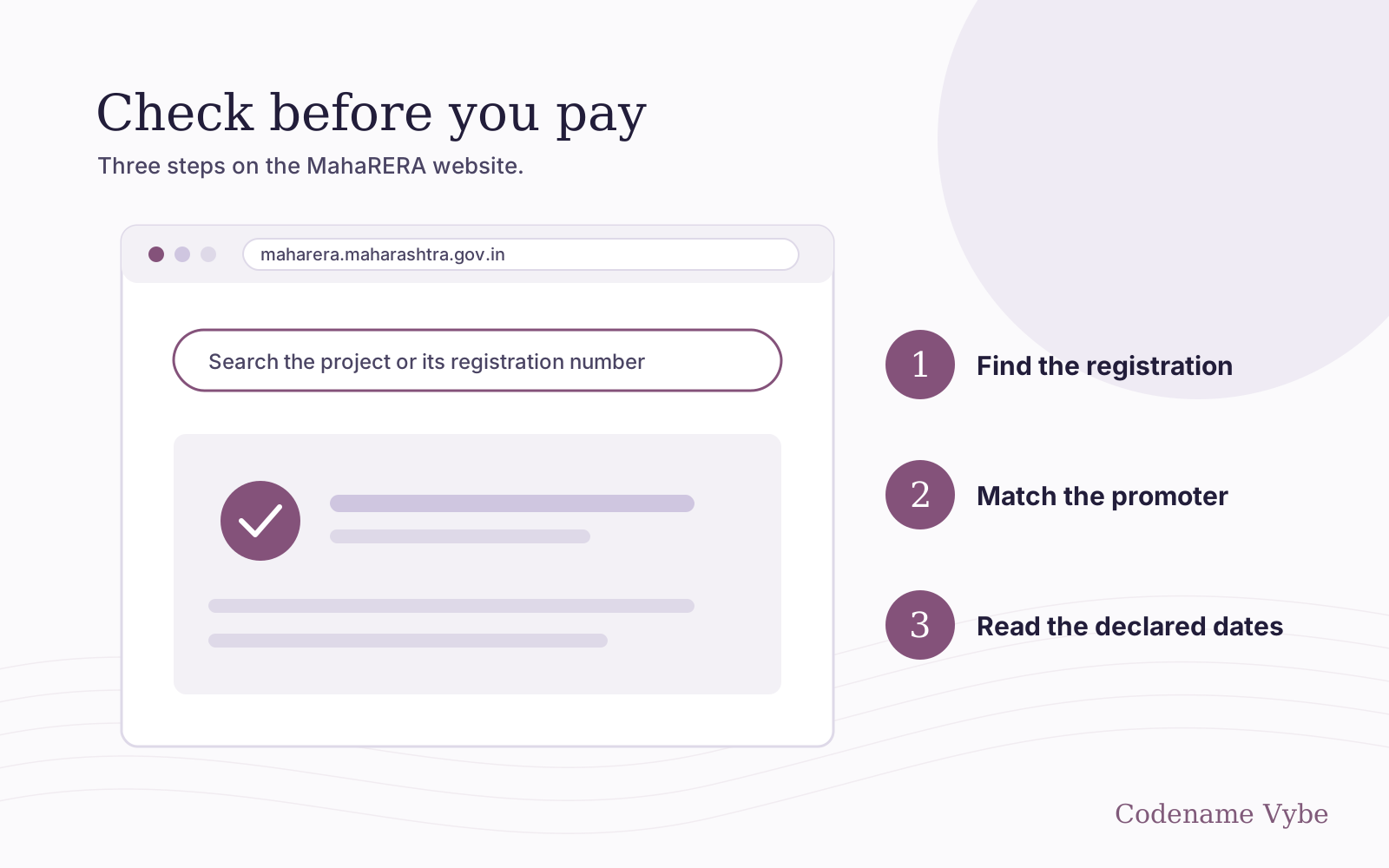
- Look up the registrations. Search both numbers above on maharera.maharashtra.gov.in, and note the completion date each promoter declared, the progress updates and any complaints. The guide to checking MahaRERA shows where to find each one.
- Take the plans. Print the floor plans and mark the unit numbers you are interested in, so your questions are specific.
- Choose your time. Go on a weekday, at the hour you would actually commute. If you can, go once more after heavy rain.
At the pre-launch site
Look at:
- The approach. How you reach the plot from Sinhagad Road, the width and condition of the lane, and how long the drive into town takes at your hour. The flyover from Rajaram Bridge to Fun Time has been fully open since September 2025, though resident reviews of the area still mention evening jams at the Fun Time signal.
- The river. Vadgaon is where Sinhagad Road runs closest to the Mutha. Ask where the plot sits relative to the river’s blue and red flood lines, and whether the land or its lane flooded in July 2024. The flood history of Sinhagad Road sets out the record.
- The neighbours. What stands on the adjoining plots, and what could be built there later.
- Water and drainage. Resident reviews of the area mention dependence on tankers in some societies and drains that overflow in heavy rain. Ask how the building will get its water.
- What is on display. Section 11(3)(a) of the Real Estate (Regulation and Development) Act, 2016 requires a promoter, at booking, to make the sanctioned plans, layout plans and specifications available by display at the site. The Supreme Court said in October 2018 that this display is mandatory, as Bar & Bench reported. Before registration there may be nothing sanctioned to show, which itself tells you where the project stands.
Ask:
- When the MahaRERA application will be filed, and which buildings and floors it will cover. The plans issued so far are for A Building, floors 1 to 11.
- Whether more buildings are planned, and in what order they will be built.
- Where the building plan approval and the commencement certificate stand.
- Where each amenity will sit in the layout, and when it will be delivered. A MahaRERA order reported by the Free Press Journal in July 2024 requires a delivery date for each amenity in the agreement for sale.
- How parking will be allotted, and whether it is covered.
- Which banks are expected to approve the project for home loans.
At the developers’ existing projects
An existing building is the best evidence you will get of how a developer builds and what happens after handover. Look at:
- Common areas: the entrance lobby, lifts, staircases, terrace and parking, and how they have aged.
- Signs of trouble: damp patches, seepage below terraces and around windows, cracks in plaster, and lifts out of service.
- Finishes against the brochure: if a resident lets you see a flat, compare the flooring, windows, doors and bathroom fittings with what was promised. For Codename Vybe, the equivalent list is on the specifications page.
Then talk to residents, away from the sales team. Ask whether possession came on the promised date, how defects were handled after handover, whether the housing society has been formed, and whether the conveyance has been done. Under Section 14(3) of the Act, a developer has to fix structural and workmanship defects reported within five years of handover, without charge, within 30 days. Residents can tell you how that worked in practice. On the MahaRERA website, check the complaints filed against each project and each promoter.
Documents to ask for
Some of these will exist only after the project is registered. Ask anyway: the answer tells you how far along it is.
| Document | What it tells you |
|---|---|
| MahaRERA registration certificate | Which buildings and phases are registered, and the completion date the promoter has declared |
| Title report, and the 7/12 extract or property card | Who owns the land, and on what terms the developer is building on it |
| Sanctioned building plan and layout | What has actually been approved, compared with what the brochure shows |
| Commencement certificate | Permission to start construction |
| Draft allotment letter and agreement for sale | The terms you would be signing, in MahaRERA’s model formats |
| Specifications and amenity list with dates | What will be fitted and delivered, and when |
| Occupancy certificate, for the existing projects | That a finished building was cleared for people to live in |
Have your own lawyer read the title papers and the draft agreement before you pay anything.
Where Codename Vybe stands
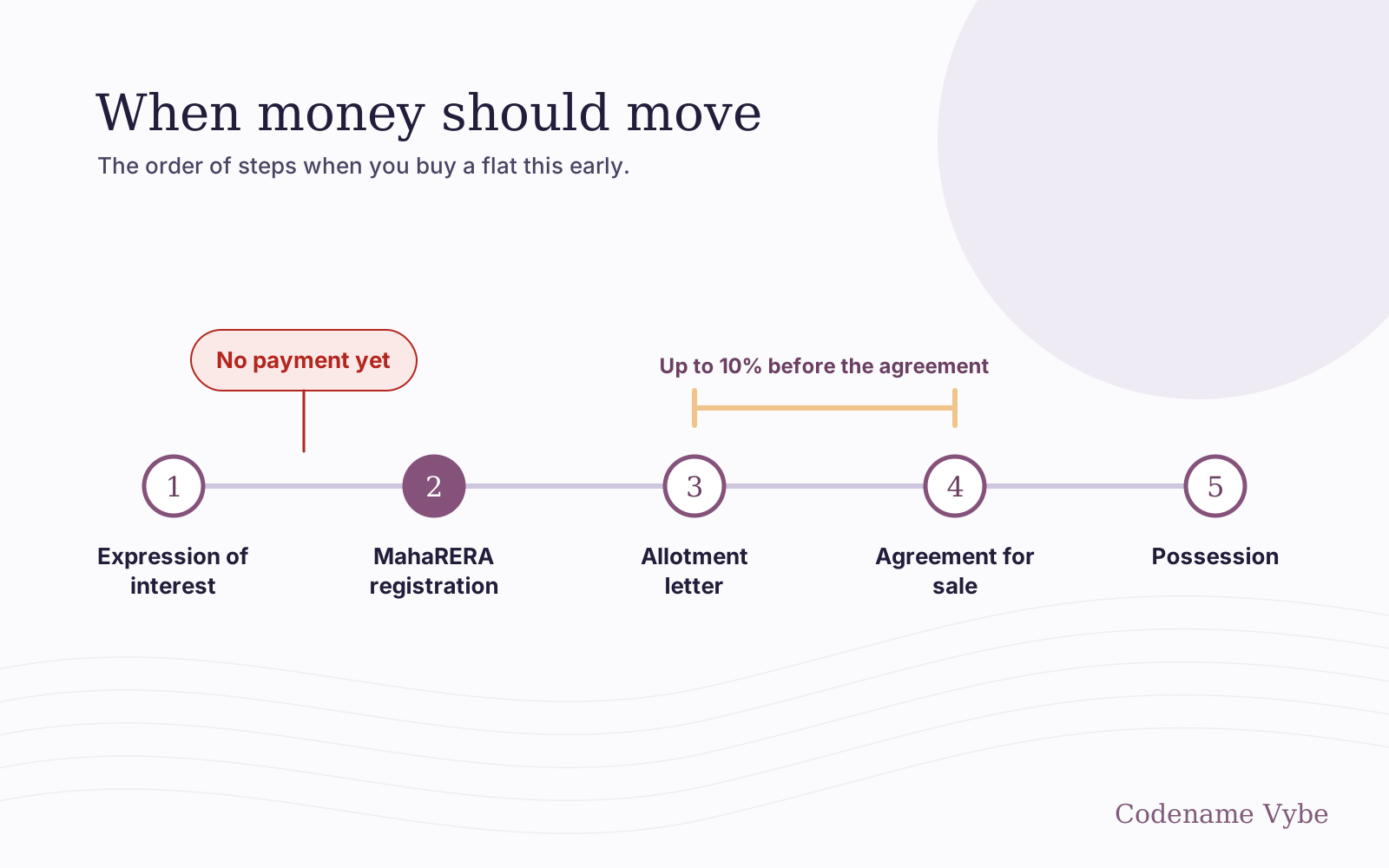
No MahaRERA registration number has been published for Codename Vybe yet, so several of the documents above do not exist yet, and no money should be paid for a home in it until the number is published and checked. The developers’ other projects are listed on the developer page.
If you would like the site location or would like to arrange a visit, ask on the contact page.